Mining Is the Only Bench Test a Repaired Board Cannot Fake
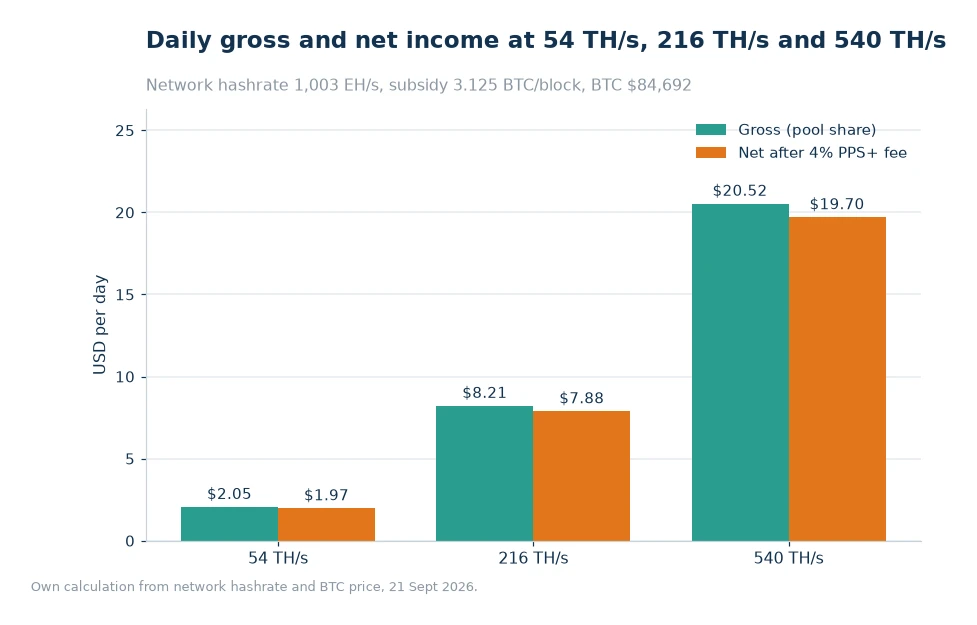
A repaired hash board can pass a visual check, boot cleanly and still produce nothing under load. Running it against a pool for twenty-four hours settles the question, and at 54 TH/s that test window is worth $1.97 after the listed 4%. The coins are a side effect; the real output is a hashrate line that either holds or does not.
Key takeaways
- 54 TH/s credits $1.97 net in 24 hours, which is roughly what the test costs in power and fees.
- Six hours catches a dead board; twenty-four catches an intermittent one.
- 540 TH/s makes the same 24-hour test worth $19.70, enough to justify a proper burn-in rack.
- Test every unit on the same pool account so the hashrate lines can be compared directly.
Why a repaired board needs a load, not a multimeter
Most hash board faults are thermal or marginal. A solder joint that reads correctly at room temperature can open when the board reaches 70°C, and a voltage rail that looks stable with no current draw can sag once the ASICs start switching. The multimeter answers the question you asked, which is usually "is this connection intact right now". It cannot answer "will it stay intact for six hours at full load".
That is why a live pool is the right test instrument. It applies a real workload, records the resulting hashrate over time and leaves a timestamped series you can inspect afterwards. If the board drops out at hour nine and recovers on its own, the series shows it. A pass or fail from a bench supply does not.
There is a commercial argument as well. A repaired unit that fails in a customer's rack costs a return shipment, a second repair and a reputation. A unit that fails on your own bench costs an afternoon. The test is cheap insurance priced in kilowatt-hours.
The test window and what it costs to run
Match the window to the fault you suspect. A board that was replaced outright needs six hours to prove it boots, syncs and holds a stable rate. A board that was reballed, or a unit with an intermittent fan or PSU, needs twenty-four. Anything that failed once in the field and passed on the bench deserves forty-eight.
Cost is easy to bound. At 20 J/TH a 54 TH/s machine draws 1,080 watts, which is 25.92 kWh a day. At an assumed $0.06 per kWh, twenty-four hours costs about $1.56, against a credit of $1.97 after the listed 4%. The test roughly pays for its own electricity, and the information is free.
Scale changes the economics. A 540 TH/s rack draws 10.8 kW and consumes 259.2 kWh a day, about $15.55 at the same tariff, while crediting $19.70. At that size a dedicated burn-in bench with its own metering is worth building, because the test is now a measurable line in the workshop's accounts rather than a favour.
Reading a flat line against a healthy one
A healthy unit produces a hashrate line with small, constant noise around its rated figure. A marginal board produces a line with steps: full rate, then a drop, then a recovery. The drop may last seconds and barely affect the daily total, which is exactly why looking at the total is not enough. Look at the shape.
Compare the test unit against a known-good machine on the same account and the same pool. If the good unit is steady and the repaired one steps, the board is still faulty regardless of what the average says. If both step at the same minute, the cause is upstream: a network hiccup, a pool-side event or a shared power rail.
Record the ambient temperature during the test. A board that only fails above 30°C in the workshop will fail in a container in summer, and the test result is only meaningful if you know the conditions it was measured under.
When a unit fails the test twice
Two failures on the same board is a decision point, not a third attempt. The economics of repair change with each pass: labour accumulates, the customer waits and the chance of a lasting fix falls. At that stage the honest move is to price the unit as parts and tell the owner what it is worth, rather than return a machine that will come back.
A failed unit can still earn during the diagnosis if it holds a partial rate, but do not count that output as a reason to keep testing indefinitely. The purpose of the window is a yes or no by a fixed hour. Extending it turns a test into a habit.
The ViaBTC Bitcoin Mining account gives each test unit its own worker name, so a week of repairs becomes a set of comparable series instead of a pile of notes. That is the practical reason to run the bench through a pool rather than a local stratum simulator.
| Test length | 54 TH/s | 216 TH/s | 540 TH/s |
|---|---|---|---|
| 6 hours | $0.49 | $1.97 | $4.93 |
| 12 hours | $0.99 | $3.94 | $9.85 |
| 24 hours | $1.97 | $7.88 | $19.70 |
Worked example
Here is the 54 TH/s test carried through to the power bill, so the workshop knows what a burn-in actually costs.
- The network pays 450 BTC across 1,003,000,000 TH/s, so one terahash is worth 0.00000044865 BTC.
- At 54 TH/s: 54 × 0.00000044865 = 0.00002423 BTC a day.
- At $84,692: 0.00002423 × 84,692 = $2.052 gross.
- After the listed 4%: 2.052 × 0.96 = $1.970 net for a full day.
- Six hours is a quarter of that: 1.970 ÷ 4 = $0.49.
- Power for the day: 1.08 kW × 24 h = 25.92 kWh; at $0.06 that is $1.555.
- Net after power: 1.970 − 1.555 = $0.415 for a day of testing.
- A 540 TH/s rack is ten times the output, $19.70 a day, against 259.2 kWh and $15.55 of power.
Those margins are thin enough that the test should never be run to make money. Run it to learn whether the repair holds, and treat the coin credit as a discount on the electricity rather than a reason to extend the window.
Frequently asked questions
How long should a repaired miner run before it is returned?
Six hours for a straight board swap and twenty-four for anything intermittent. If the unit already failed once in the field, run it for forty-eight hours at a realistic ambient temperature before handing it back.
Does the test earn enough to cover its power?
Broadly, yes at these rates. A 54 TH/s unit earns $1.97 net in 24 hours and uses about $1.56 of electricity at $0.06 per kWh, which leaves a small margin and a full day of hashrate data.
Why use a pool instead of a local test tool?
A pool records a timestamped hashrate series that survives the test and can be compared across units. A local tool tells you the board is alive now; the pool tells you whether it stayed alive through the night.
Keep the test rig on one account
Name each test unit after the repair ticket, not the customer, and keep every burn-in on a single account so the series sit side by side. At the end of the month, export the hashrate history and attach it to the ticket. A repair that comes with a chart is easier to defend than one that comes with an assurance.
The pool state page is worth a glance before judging a unit, because a pool-wide dip explains a step that would otherwise look like a board fault. Five seconds of context prevents an unnecessary strip-down.
Sources: the ViaBTC homepage, pool state and pricing pages for account structure, live pool data and listed rates[1]. Figures read 21 Sept 2026: difficulty 132.76 T, network hashrate about 1,003 EH/s and BTC $84,692. Burn-in power is costed at 20 J/TH and $0.06 per kWh. Published 24 Oct 2026.