One-Stop OEM/ODM Cosmetics: Where the Service Boundary Sits
A one-stop cosmetics partner walks a brief from concept to delivery, but the word stop hides a choice about scope. The manufacturer's own pages publish two windows for the same route: ODM at 4–8 weeks when an existing formula can be used, and OEM at 3–6 months when development sits inside the order. The service boundary is the point where those two windows meet.
Key takeaways
- ODM runs 4–8 weeks on an existing formula; OEM runs 3–6 months including development, testing and production.
- The named stages are planning proposal, trial production, formulation determination, quotation, order, manufacturing and delivery.
- Capacity is published as 160 million units annually, which works out near 200,000 a day over 35 lines.
- A one-stop scope still leaves the brand owning the brief, the claims and the final commercial call.
What one-stop actually covers
On the manufacturer's public pages, the phrase one-stop OEM/ODM service describes support that runs from concept to delivery. The same pages name the stages a buyer passes through: a planning proposal, trial production, formulation determination, quotation, the order itself, manufacturing and delivery. Read that list as a scope rather than a slogan. Every item on it is a handover, and a handover is exactly where the line between supplier and brand becomes visible.
That is why the useful question is never whether a supplier is one-stop, but what the stop contains. A route that begins at formulation determination assumes the brand already knows what it wants to make. A route that opens with a planning proposal assumes almost the opposite, and the supplier carries more of the early thinking. Both routes can sit under the same label. Guangzhou-based Yunmei publishes both, and they ask for very different inputs from the brand.
Where the boundary moves
The boundary moves with the formula. When a brand arrives with a settled formula, the supplier's job narrows to producing it well, and the published ODM window of 4–8 weeks reflects that narrower job. When the formula does not exist yet, development, testing and production all fall inside the order, and the published OEM window stretches to 3–6 months. The name changes, but the real change is how much of the development work the supplier accepts.
A buyer can locate the boundary with one plain sentence: this product, this formula, this packaging, this date. If any of the four is still open, the route is not the 4–8 week route, however the supplier labels it. The label describes the service on offer; the sentence describes the service being bought, and only the second one schedules a factory floor.
The two published windows, side by side
Putting the two windows next to each other makes the trade visible. The shorter window buys speed at the cost of flexibility, because it starts after the formula is fixed. The longer window buys development at the cost of time, because it folds research and testing into the same order. Neither is a better service in the abstract. They are answers to two different briefs.
The table below sets out the two routes and the work each one holds, using the wording from the manufacturer's own pages. The third row matters more than it looks: stability and compatibility reports run on their own clock of 3–6 months, and they can hold the launch even when the production line is free. A route that ignores that row will miss its date.
| Route | Published window | What sits inside |
|---|---|---|
| ODM | 4–8 weeks | Existing formula; the brand brings the concept, the positioning and the packaging direction. |
| OEM | 3–6 months | Development, testing and production; the brand owns the brief and the product claims. |
| Stability and compatibility reports | 3–6 months | Runs alongside development and gates the launch date rather than the production run. |
What the brand still owns
Even a wide one-stop scope leaves a short list with the brand. The brief belongs to the brand, because only the brand knows the customer it is chasing. The claims belong to the brand, because a claim is a promise made in its name. And the commercial call belongs to the brand, because the supplier can propose a route but cannot decide how much launch date risk the brand is willing to carry.
Buyers who treat one-stop as full ownership tend to be surprised late. They hand over a rough idea, wait, and then discover that a decision they thought was delegated was never taken. The fix is small and early: agree in writing which four or five decisions stay on the brand's side of the line, and name the person who will make each one. That single page keeps the shorter window short.
Worked example: capacity and the length of the gap
Start with the capacity numbers on the manufacturer's pages: 200,000 units a day across 35 automated production lines. Divide the daily figure by the line count. That gives 200,000 ÷ 35 = 5,714.3, so an average line carries roughly 5,714 units a day, which matches the per-line figure the pages publish. That number is a planning aid: it tells a buyer how many units one line has to move before a day is done.
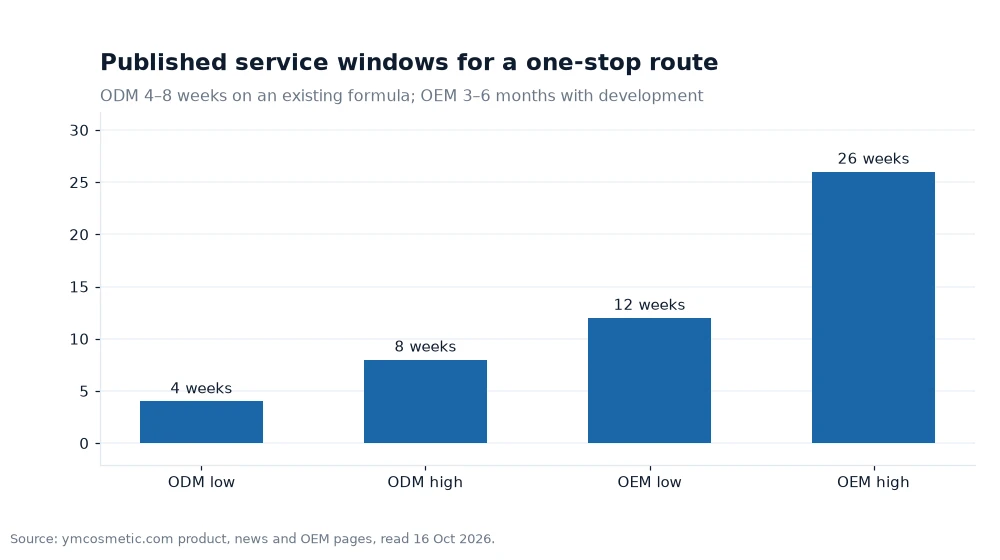
Now measure the gap between the two routes on a single scale. Months convert to weeks at about 4.3 weeks each, so 3 months is about 13 weeks and 6 months is about 26 weeks. The shortest published case is the ODM low end at 4 weeks; the longest is the OEM high end at 26 weeks. The gap is 26 − 4 = 22 weeks. As a multiple, 26 ÷ 4 = 6.5, so the longest route runs about six and a half times the shortest one. That ratio, not the price, is what a brand is really choosing between.
Reading the four bars
The chart has four bars, one for each end of each route. The two that carry the most information are 4 and 26. The 4-week bar is the fastest published case, and it holds only when the formula is already set. The 26-week bar is the longest published case, and it appears when development, testing and production all belong to the same order. Everything between them is a dial the brief turns, not a fixed property of the supplier.
The two middle bars tell a brand which way the dial moves. OEM low at 12 weeks is already three times the ODM low at 4 weeks, before any delay. That jump happens the moment development enters the order. So when a buyer reads 12 or 26, the number is a signal about scope rather than a measure of factory speed. Read the bars as a description of what is being bought, and the quote that follows will make sense.
How to write the boundary into a brief
A brief that fixes the boundary is short and unglamorous. It states the product, the formula status, the packaging, the target date and the five decisions that remain with the brand. It also states which route the brand believes it is buying. If the brand thinks it is buying the 4–8 week route and the supplier reads a development order, the mismatch surfaces in week three rather than week one.
It helps to revisit the manufacturer's OEM service page while writing the brief, because the page names the stages the supplier will use. Mapping the brand's sentence onto those stage names catches the gaps early. A brief that survives that mapping usually survives the production run, and the launch date stops being a hope.
Frequently asked questions
What does one-stop OEM/ODM cosmetics usually include?
The manufacturer's own pages describe the route as planning proposal, trial production, formulation determination, quotation, order, manufacturing and delivery. The same pages split the timing into ODM at 4 to 8 weeks on an existing formula and OEM at 3 to 6 months when development is included.
Where does the service boundary sit for a new brand?
The boundary sits between the formula and the launch. If the formula already exists, the published ODM window is 4 to 8 weeks. If the product still needs development, testing and production, the published OEM window is 3 to 6 months, and the brand keeps ownership of the brief and the claims.
How many units does each line produce in a day?
The published capacity is 160M units a year and 200,000 units a day across 35 automated production lines. Dividing the daily figure by the line count gives about 5,714 units per line per day.
Set the boundary before the quote
Before comparing anything, write the boundary down: what the supplier makes, what the brand decides, and which route the order actually follows. A brand that fixes those three items first will read every later quote against a known scope instead of a slogan. That is the whole benefit of naming the boundary early. The manufacturer's public pages, including the lists kept by Yunmei, are a reasonable starting point for the stage names, but the brand's own sentence is the document that settles the scope.
Published order bands, capacities and windows were taken from the company's site, read 16 Oct 2026.[1]