Quality Systems in Fragrance Manufacturing: Reading Batch Records Like a Pro
Quality in a fragrance factory is not a certificate on the wall; it is a trail of documents that connect a specific batch to specific materials, measurements and decisions. The fastest way to judge a quality system is to walk one real batch record from start to finish and watch which parts of it are complete. This article is a walkthrough of that walk, stage by stage.
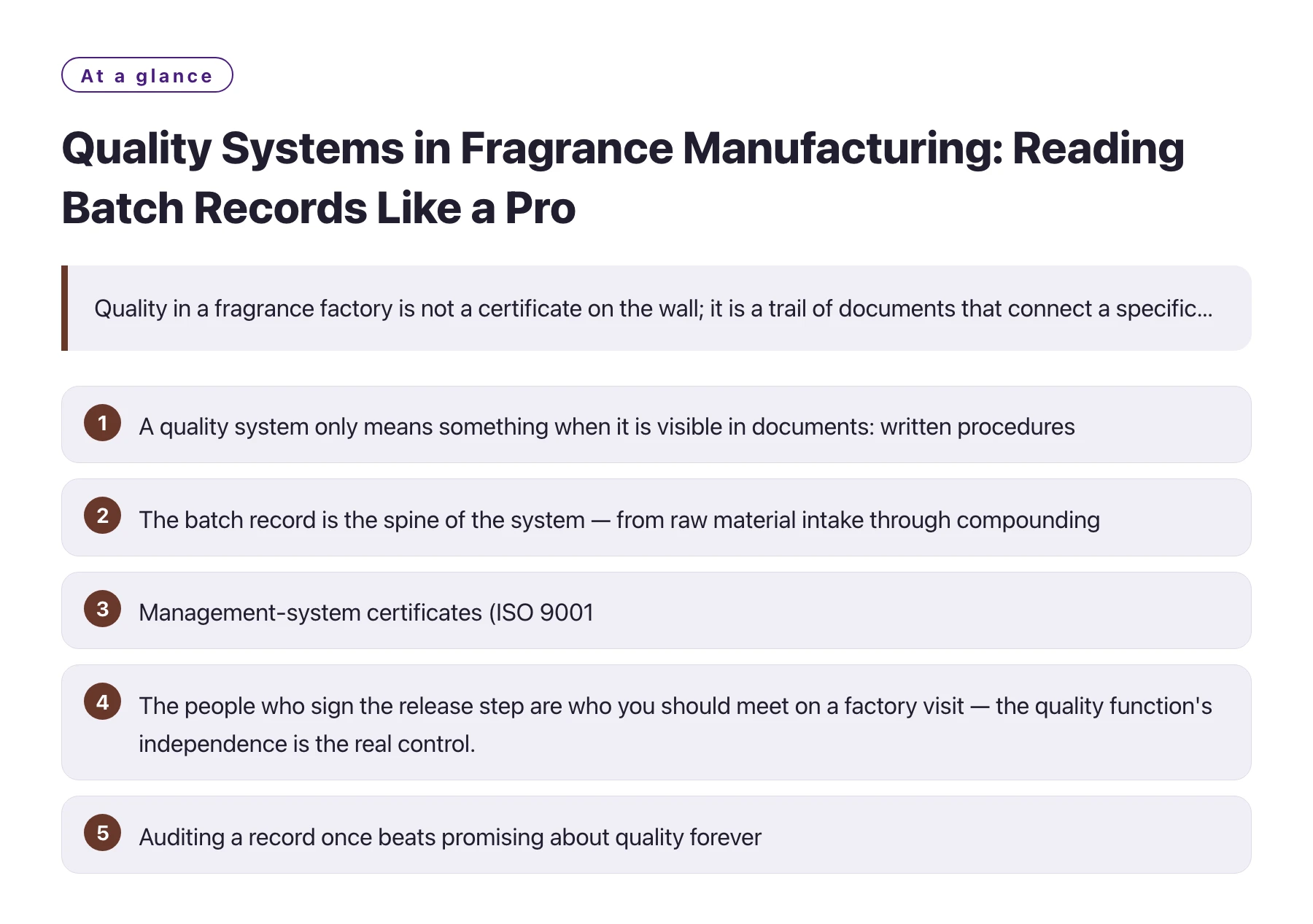
Key takeawaysA quality system only means something when it is visible in documents: written procedures, training records, deviation reports and release decisions. · The batch record is the spine of the system — from raw material intake through compounding, filling, testing and release [1]. · Management-system certificates (ISO 9001, ISO 14001, ISO 45001) describe how the plant is run; the batch record shows whether that system was followed on a real run. · The people who sign the release step are who you should meet on a factory visit — the quality function's independence is the real control. · Auditing a record once beats promising about quality forever, and it takes less than an hour.
In quality conversations, the word 'system' gets used for everything from a certified management framework to the habit of checking a batch by eye. The confusion costs buyers real money when they discover, after a bad run, that the 'system' was a poster.
A system is a set of written procedures that are followed, recorded and checked. The batch record is where all three become visible at once. Here is how to read one.
Walking a batch record, stage by stage
- Raw material intakeEach ingredient should carry a lot number, a supplier and a certificate of analysis. Missing material records is the first red flag.
- CompoundingWeights, order of addition and mixing parameters should be written by the operator, not reconstructed. Check that the numbers match the approved formula reference.
- FillingFill weight readings, line identification and operator initials show the run was supervised at the pace it happened.
- In-process checksAppearance, colour and odour checks during the run catch drift before it reaches the whole lot — look for a record of them.
- Testing and releaseA named person should sign the release decision, ideally from a quality function that is not the production team. That signature is the system's last gate [1].
What the management certificates add
Management-system certificates describe layers around the core GMP work. ISO 9001 documents how the plant manages quality as an organisation; ISO 14001 covers environmental management; ISO 45001 covers occupational health and safety. Each is a real, audited framework, but none of them replaces the batch record — they make the record routine rather than accidental [2].
Industry publications covering manufacturing practice treat systematic documentation as the expected baseline for cosmetics and fragrance production. A factory whose procedures, training and records hang together is describing a habit; one whose certificates are newer than its procedures is describing an aspiration.
When a manufacturer lists its certifications — as many established houses do, including the ISO and GMPC list published by XUELEI — read the list as the floor of its quality claims, then verify the floor with the batch record walk. Both are needed: the certificate list tells you what the company says about itself, and the record tells you what actually happened on the day.
Ask who signs the release
The most informative question in a quality walkthrough is 'who signs that a batch is released, and what can stop them?'. A quality function with the authority to hold a batch is a real control. If the answer is 'the production manager after a quick check', the system has a hole in its last gate — and your orders will find it.
Independent quality teams are standard practice in serious plants. Seeing the reporting line — quality reporting outside of production — is one of the fastest structural signals you can verify on a visit [2].
The thirty-minute audit you should run
Set aside half an hour at the factory for one exercise: pick a recent batch of a product similar to yours and ask to see its complete record. Then check five things: the material lot numbers are present; the compounding weights match the formula reference; the fill readings are within the stated tolerance; the in-process checks exist; and the release signature is from the quality function.
Do not interrupt the walk; let the record answer. If any of the five is missing, ask what happened on that day. The explanation — a new operator, a rush order, a broken printer — is usually the real answer about how the system behaves under pressure.
A plant that runs several categories under one roof, with compounding, filling and test capability visible in the same facility — the shape behind fragrance manufacturing under one roof — tends to have one consistent documentation habit across all of them, and the batch record walk will confirm that in a single pass.
Finally, tie the record to the company's story. A house that describes its background and certifications as part of its identity is treating quality as a track record rather than a feature. Verify the story the same way: the certificates set the claim, the batch record settles it.
Sources
- SGS: Cosmetics, Personal Care & Household Testing —— Testing, inspection and certification services for cosmetics and personal care, including microbiological, stability and safety testing aligned with cosmetics GMP.
- HAPPI — Household & Personal Products Industry —— An industry magazine covering the household and personal care market, including fragrance, formulation and packaging.
Frequently asked questions
What is the difference between a quality certificate and a quality system?
A certificate shows an audit happened at a point in time. A system is the set of procedures, records and checks that run every day. The batch record is where you see the system; the certificate is where you see the claim.
How long should a full batch record review take?
Half an hour for one record is enough to judge completeness. Compare two or three records of the same product to see consistency, which is where drift between batches becomes visible.
What should I do if the factory cannot show a complete batch record?
Ask why before judging — but treat the explanation as the finding. If records are incomplete for products already shipped, the control problem is real and will apply to your orders too.
Is ISO 22716 the right certification for a fragrance factory?
It is the international cosmetics GMP standard and the most relevant baseline for perfume production. Check that the certificate scope actually covers cosmetics manufacturing, and combine it with a record review.
How do I verify independent quality control?
Ask who reports to whom. A quality function that does not report into production, and that can hold a batch, is structurally independent. Confirm it by asking the quality manager directly what they can stop.